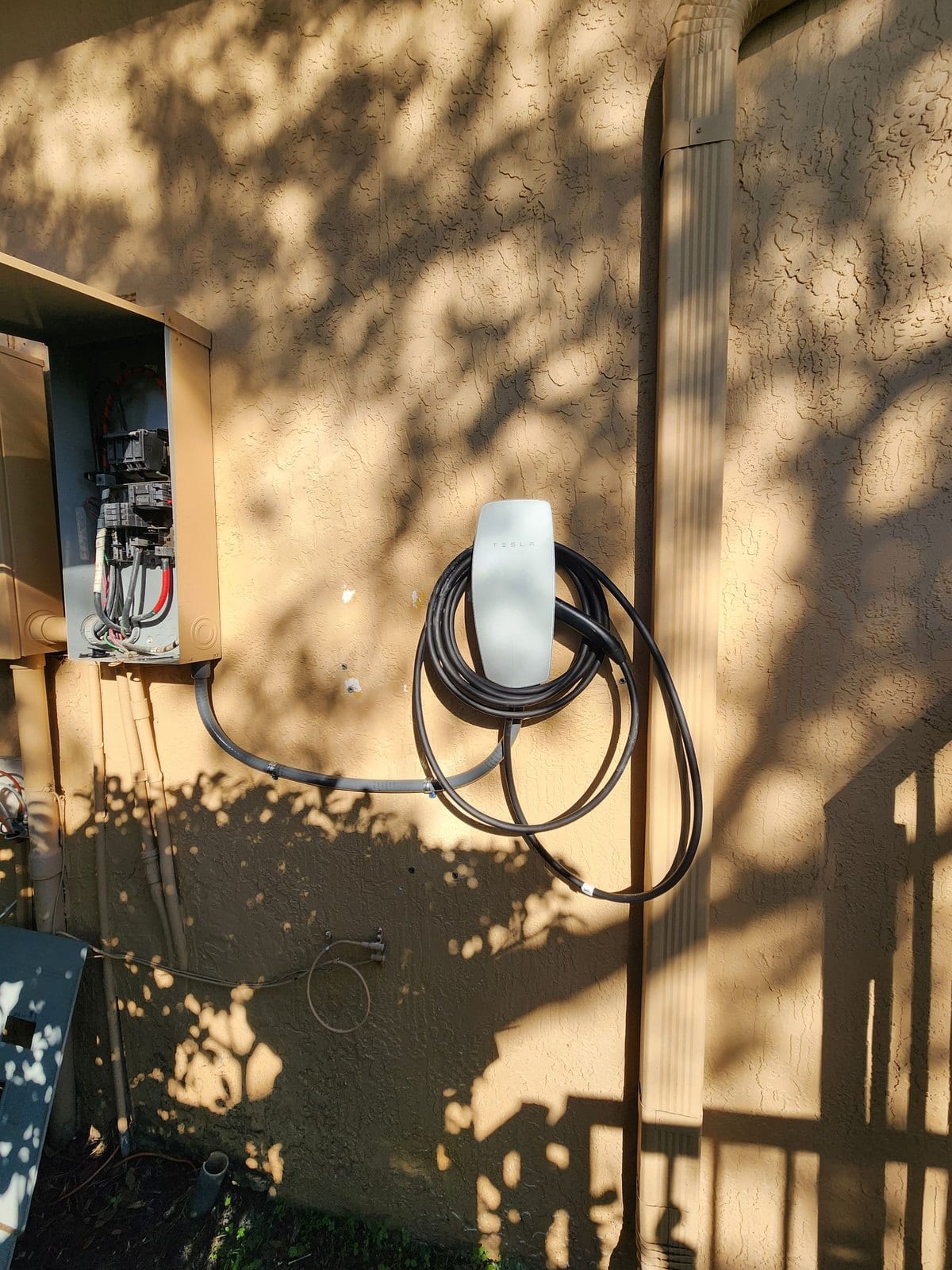
A Level 2 charger is one of the largest continuous loads a house will ever carry, and in a region where a great deal of housing still runs on its original service, the honest answer to "can you fit one" is sometimes "not until we look at the panel". Frazier Electrical Solutions LLC installs EV chargers across Miami-Dade and Broward County, with the load calculation done before the quote rather than after the equipment arrives.
That sequence is the whole point. A 40 or 48-amp charger drawing for hours at a time is not a load to add optimistically. On a 200-amp service in Doral or Pembroke Pines it is usually straightforward. On the 100 or 150-amp service still feeding much of North Miami, Hollywood and the older coastal neighborhoods, it frequently is not.
Why choose Frazier Electrical Solutions LLC
- Load calculation first, always. We work out what the service has spare before anyone discusses which charger to buy.
- We will tell you if the service needs upgrading. Not the answer anyone wants, but considerably better than hearing it after the charger is on the wall and the main breaker starts tripping.
- Condo and garage installs included. High-rise and association garages are a different job — metering, route, approvals — and we handle that side rather than leaving you to negotiate it.
- Hardwired or receptacle, explained. A 14-50 receptacle and a hardwired unit are not interchangeable; the choice changes the breaker, the GFCI requirement and what you can do later.
- Licensed Florida electrical contractor, EC #13012609. Permitted and inspected, which matters for insurance and at resale.
Our EV charger process
- Establish the car and the charger. Amperage, connector, whether a second vehicle is likely, and whether you want the capacity now or later.
- Run the load calculation. Existing service, existing loads, and the charger's continuous draw at 125 per cent.
- Give you the real options. Install as-is, install at a reduced amperage the service can carry, or upgrade the service first — with a price against each.
- Plan the route. Panel to parking space, allowing for block walls, which side the car's port is on, and cable length.
- Install, permit, inspect. Dedicated circuit, correct protection, permitted through the right building department, and tested with the car before we leave.
What makes this a South Florida question
The construction, first. Most houses here are concrete block, so running a circuit from an indoor panel to a garage or carport is not a matter of dropping through a stud bay — it is surface raceway, an attic route or a chase in the block, and that changes the labour rather than the materials.
The climate, second. A charger on an exterior wall or in an open carport is outdoor equipment in a salt-laden, high-humidity environment, and it needs to be treated as such: correct enclosure rating, correct fittings, and a disconnect that will still operate in five years.
The condo question, third, and in this market it is a big one. A very large share of Miami-Dade and Broward residents park in a shared garage, which makes charging a building conversation: what the garage's capacity is, how the association wants it metered and billed, and who owns the equipment. We assess the garage and put the options to the board in writing, which is usually what moves it forward.
And capacity, fourth. A house that has added impact windows and a bigger AC system, a pool heater and a summer kitchen has less headroom than its panel label implies. The calculation is the only thing that tells you the truth.
Serving Miami, FL and nearby
Miami, Miami Beach, Coral Gables, Doral, Aventura, North Miami, Fort Lauderdale, Hollywood, Hallandale Beach and Pembroke Pines.
Call or text (786) 292-1194 with a photo of your panel and the charger you are considering.